AI belongs in the practice, not on top of it.
The microscope didn’t turn biology into the study of lenses.
It gave biologists a new way to observe, and a new question to ask: is that structure real, or an artifact of how I prepared the slide? Computer vision, clustering and generative models work the same way. The phenomenon under study does not change; the AI is the instrument, not the subject.
So AI does not arrive as a new unit competing for days you do not have. It arrives inside the practices you already teach: planning and carrying out investigations, analyzing and interpreting data, developing and using models.
The three instruments
Each is a genuine scientific tool with the complexity turned down. The controls are simplified, but the scientific function is intact, and each one carries a question the student has to answer.
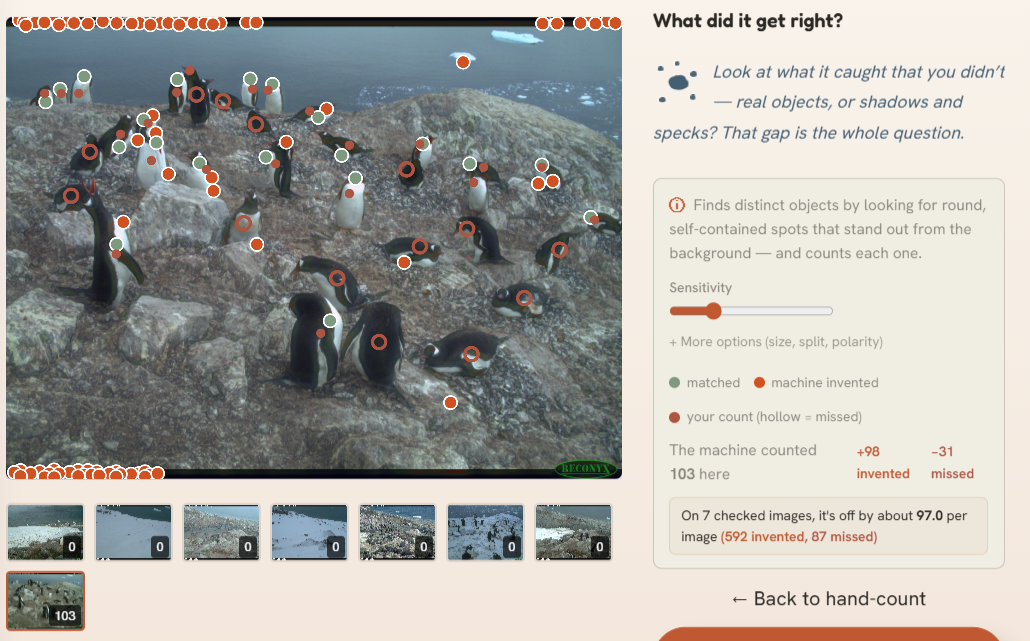
Students pick a detection method, tune its sensitivity, and set the instrument’s count beside a hand count of the same image.
The built-in checkDid it count the thing you meant, or an artifact of the image?
More instruments sit alongside these: tracking, audio classification, regression, and ML surrogates.
Every instrument comes with a way it can mislead you
An AI instrument never enters a lesson without its reflection point: the assumption or failure mode that could undermine the conclusion. It is built into the instrument, not added afterwards as a worksheet question. This is the same skepticism science already relies on, applied to a new kind of instrument, which is what keeps the lesson a science lesson rather than a lesson about AI.
What you do: three screens
There is no template, no configuration screen, and no login to get started. Across three screens, most of what you do is choosing rather than building.
- 1
Start with what you have
Type a research question, or drop a CSV, a video, or a folder of images. The platform reads the data and proposes candidate investigations from it.
- 2
Choose the investigation
Pick from a small set of investigation cards. Each shows the question, what students will do, and a thumbnail of your real data on the columns it would use.
- 3
See it before it exists
Every phase renders the actual screen students will see. Edit the few regions that are yours, then walk the whole thing yourself before launching.
Launch puts a join code on the board, and students join with a name, no accounts needed. Your own device then shows the class as a river, with one marker per student at the phase they are actually in.
Inside the standards you already teach
Every instrument is anchored to a science and engineering practice from the NGSS framework. What accumulates across a year is not a catalogue of algorithms but a map of where AI enters science, what job it does, and how it fails there. That map is the AI literacy a scientifically literate adult now needs.
| Practice | AI instrument | What students confront |
|---|---|---|
| Planning and carrying out investigations | Computer vision: detection and counting, tracking, audio classification | Did it measure what I meant it to measure? |
| Analyzing and interpreting data | Clustering, regression | Is this structure in the data, or in my choices? |
| Developing and using models | Generative modeling, symbolic regression, ML surrogates | Did it build what I specified, and does the evidence support it? |
Honest about the stage we’re at
There is no chatbot here. The assistant knows only the activity and the student’s own work, and it points back to the evidence instead of handing over an answer.
This is a design argument backed by a published vision, not a finished efficacy claim. Whether operating these instruments builds the literacy we argue for is an empirical question, answered in classrooms. We are watching two risks in particular: over-reliance on fluent output, and the preparation that placing these instruments well asks of teachers.